

My last post introduced the idea of creating a five-question Change Story to communicate the what and why of a change you’re leading. The premise is straightforward: Leaders at every level need a coherent story that makes the case for the change.
There’s another equally important consideration:
When is it time to stop seeking input so you can make a decision and act?
In a recent team coaching session, two participants found themselves on opposite sides of that question.
One argued that, over time, it pays to gather more input. You get better decisions and stronger buy-in.
The other pointed out the downside: endless discussion, slow progress, and attention pulled away from the real work.
Each was making a strong case for one side of a polarity.
Have you ever found yourself leaning one way or the other? I know I have. What if we step back and look at this as a both/and?
In my last post, I referenced a framework that helps leaders determine the appropriate level of input to seek before making a decision. When paired with a Change Story, it creates clarity about where influence is possible—and where it isn’t.
Let’s look at a familiar example.
Your office is moving in three months. You know people will have concerns. You’ve created a Change Story to explain the move, but there’s no real upside from their perspective. So you invite input on how to make the move more palatable.
People engage. They share ideas.
But most of the ideas aren’t feasible.
Now what?
When people are invited to give input that can’t be used, frustration—and even cynicism—follows. They thought they had influence. They didn’t.
To avoid that, it helps to be intentional about the level of involvement you’re offering.
Below is a simple framework (adapted from The Fifth Discipline Fieldbook) that outlines increasing levels of input in decision-making or vision-setting.
It’s not meant to be rigid. Real life is messier than this. But it’s a practical way to answer three key questions:
Is the decision already made?
If not, how much influence do others actually have?
Am I being clear about that?
Levels of Involvement
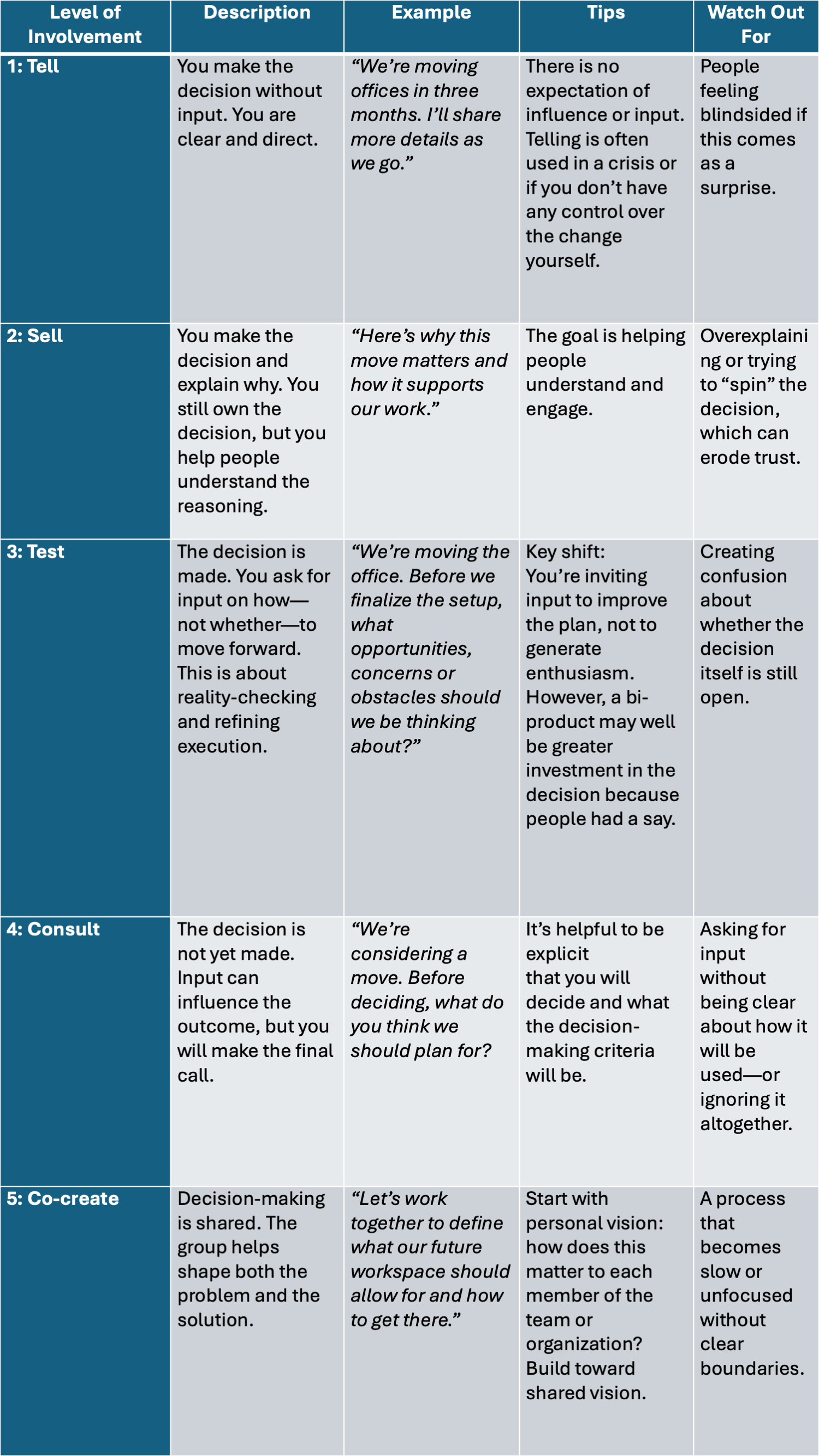
You avoid a lot of unnecessary frustration when people are clear about what they can influence and what they can’t.
Try this: Before asking for input, pause and ask yourself where you are on this spectrum—and be explicit about it.
You may find your change efforts move more smoothly, with fewer false starts and less rework.
I’d be curious to hear how you’ve navigated this tension in your own work.